
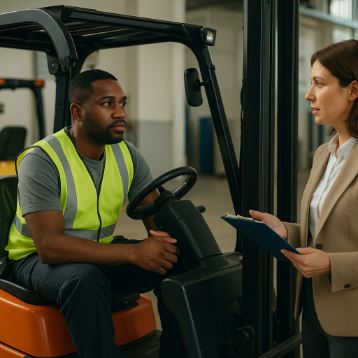
Forklift operation can look routine, but it never becomes risk-free. Warehouses change layouts, loads vary, pedestrians move unpredictably, and even experienced operators can slip into habits that weaken both safety and performance. That is why refresher training matters. A well-designed course does more than revisit basics; it sharpens judgment, corrects unsafe shortcuts, reinforces current procedures, and helps employers maintain a safer, more consistent operation. For businesses and operators alike, refresher learning is one of the most practical ways to keep forklift skills current and compliant.
Why refresher courses matter
Initial operator training is only the starting point. Over time, even capable forklift drivers can develop blind spots. Familiarity often creates confidence, but it can also reduce attention to detail. A refresher course brings operators back to core principles such as load stability, visibility, speed control, turning radius, battery or fuel handling, inspection routines, and safe interaction with racking, loading bays, and foot traffic.
Refresher training is also important because workplaces rarely stay static. New attachments, different truck types, tighter storage systems, seasonal surges, revised traffic routes, and changing health and safety procedures all affect how a forklift should be operated. A driver who was competent in one setup may need updated instruction in another. In that sense, refresher courses are not remedial. They are part of normal professional upkeep.
Compliance is another key reason. Employers have a duty to ensure that powered industrial truck operators remain competent for the tasks they perform. In many workplaces, that means documenting training, evaluation, and any corrective instruction after incidents or operational changes. A refresher course helps demonstrate that forklift use is being managed actively rather than assumed to be under control.
When forklift refresher training should take place
There is no single universal schedule that fits every workplace, because the right interval depends on risk, environment, equipment, and company policy. What matters most is recognizing the situations that clearly call for retraining or reevaluation. Waiting until there is a serious incident is the wrong approach.
Common triggers for refresher training include:
- After an accident or near miss: Any collision, dropped load, tip risk, or unsafe maneuver should prompt review and, where needed, retraining.
- After observed unsafe operation: If a supervisor sees speeding, poor stacking, distracted driving, improper horn use, or incomplete checks, skills should be reinforced immediately.
- When workplace conditions change: New layouts, ramps, dock systems, storage heights, traffic patterns, or narrow aisles can alter safe operating practice.
- When equipment changes: Moving from one truck type or capacity to another may require updated instruction and evaluation.
- After a long gap in operation: If an employee has not used a forklift for an extended period, a refresher course can rebuild confidence and safe habits.
- As part of periodic competency review: Even without an incident, regular reassessment helps prevent complacency.
The goal is not simply to refresh memory, but to confirm real-world competence. That means pairing classroom review with practical observation. Operators should leave the course better able to make sound decisions under normal working pressure.
| Trigger | Why it matters | Refresher focus |
|---|---|---|
| Incident or near miss | Signals a possible gap in judgment or technique | Hazard awareness, control measures, practical correction |
| New equipment | Operating characteristics may differ | Controls, load limits, attachments, maneuvering |
| Site layout change | Traffic flow and visibility risks shift | Route discipline, pedestrian safety, stacking procedures |
| Time away from operation | Skills and confidence may decline | Pre-use checks, core handling skills, safe pace |
| Routine review | Prevents bad habits from becoming normal | Best practice, compliance, practical evaluation |
What a strong refresher course should cover
Not all refresher courses are equally useful. The best ones are targeted, practical, and relevant to the equipment and environment the operator actually uses. A generic slide presentation with little hands-on assessment may tick a box, but it will not reliably improve performance.
An effective course should revisit three core areas:
- Safety principles and legal responsibilities
Operators should understand why rules exist, not just memorize them. That includes stability concepts, load center awareness, speed management, safe parking, visibility limitations, and duties around inspections and reporting. - Workplace-specific hazards
The training should address actual site conditions: congested aisles, uneven surfaces, loading docks, trailer entry, cold storage, mixed pedestrian traffic, outdoor use, or multi-shift operations. - Practical operating skill
Refresher learning should involve supervised driving, load handling, stacking, reversing, cornering, and pre-use checks. Operators benefit most when trainers observe performance and correct technique in real time.
A strong refresher course also leaves room for discussion. Experienced operators often raise the most valuable questions because they understand the pressures of live operations. Addressing those practical concerns makes the training more credible and more likely to influence day-to-day behavior.
Supervisors can support better outcomes by using a simple post-training checklist:
- Confirm the operator was evaluated on the equipment they use
- Review any site-specific hazards discussed during the course
- Document corrective points and follow-up actions
- Monitor performance in the first days after training
- Schedule periodic observations rather than waiting for problems
Choosing an accredited training center for forklift refresher courses
The quality of the provider matters. A refresher course should be led by trainers who understand both formal safety expectations and the realities of industrial work. Choosing an accredited training center can help employers feel more confident that the instruction follows recognized standards, includes proper assessment, and produces records that support internal compliance procedures.
When reviewing providers, look beyond convenience and price. A reputable accredited training center should be able to explain how its refresher courses are structured, what equipment types are covered, how practical competence is evaluated, and what documentation is provided at the end. That conversation often reveals the difference between serious training and a minimal box-ticking exercise.
It is also worth asking a few direct questions before booking:
- Is the training matched to the specific class of forklift in use?
- Does the course include hands-on evaluation, not just theory?
- Can site-specific hazards or company procedures be incorporated?
- Are supervisors given feedback on operator performance?
- Is the documentation clear enough for internal safety records?
The best provider is not necessarily the one offering the fastest turnaround. It is the one that helps operators return to work better prepared, more aware, and more consistent in safe practice.
Making refresher training part of everyday safety culture
Refresher courses work best when they are part of a broader safety culture rather than an isolated event. If production pressure constantly overrides safe loading, speed discipline, or pre-use inspections, even excellent training will lose its effect. Operators notice quickly whether standards are reinforced on the floor or only mentioned in a classroom.
Managers and supervisors play a central role here. They should carry training lessons into daily operations by observing driving behavior, correcting unsafe shortcuts promptly, and recognizing careful, professional work. Short toolbox talks, clear pedestrian routes, visible signage, and consistent reporting of near misses all help extend the value of formal refresher instruction.
Operators also benefit when expectations are explicit. A simple framework can keep standards visible:
- Inspect before use so defects are found early.
- Drive to conditions rather than to habit or urgency.
- Handle loads conservatively with attention to weight, height, and stability.
- Respect shared spaces where pedestrians, doors, corners, and vehicles create changing risks.
- Report issues promptly so hazards are corrected before they escalate.
When those behaviors are reinforced consistently, refresher training becomes more than a compliance measure. It becomes a practical tool for protecting people, stock, equipment, and workflow.
Conclusion
Forklift operation depends on concentration, judgment, and technique every single day. Experience matters, but experience alone is not enough to guarantee safe performance over time. Refresher courses give operators the chance to revisit core skills, correct drift in habits, adapt to workplace changes, and meet compliance expectations with confidence. For employers, investing in a strong program through an accredited training center is a sensible way to support safer operations and more dependable standards. In a working environment where small mistakes can have serious consequences, keeping forklift skills sharp is not optional; it is part of doing the job properly.
Find out more at
Forklift Operator Training
https://6916d72041d4b.site123.me/
0875106600
Linpopo
Forklift Training in Thulamela Thohoyandou Thabazimbi Giyani Jane furse
Forklift Training in Thulamela, Thohoyandou, Thabazimbi, Giyani and Jane furse – Please note that all Companies in South Africa MUST only employ licensed forklift Operators and all licensed operators need to provide proof of previous training when inspectors come to your company. In order to book further courses like the refresher forklift training that can be on-site or off-site. Regular Refresher forklift training will ensure that operators are updated on the new legislations, new technologies and it helps them to maintain good driving habits, learn new skills where appropriate, and reassess their skills. Training or retesting may also be appropriate when the operator has the following conditions: We offer free Accommodation for the distant learners so if you are in Gravelotte, Haenertsburg, Hoedspruit, Klaserie, Lebowakgomo, Lephalale, Letsitele, Leydsdorp, Afguns, and Alldays or anywhere in South Africa or the SADC countries we have you covered accommodation wise and our forklift training prices are affordable.
Register for refresher Counterbalance Forklift Training in Thulamela, Thohoyandou, Thabazimbi, Giyani and Jane furse and Limpopo Province as a whole.


